

7 Recovery Milestone Display Ideas for Your Sobriety Chips
Last Updated: October 26, 2026
Quick Summary
A recovery milestone display keeps your sobriety chips visible as a daily reminder of your progress and commitment to recovery. Seven display options range from expandable chains that grow with your journey to shelf displays, wall timelines, shadow boxes, desk reminders, portable cases, and private options that suit different spaces, budgets, and recovery stages.
- Expandable chains from Recovery Time Links start at $9.99 per link with volume discounts available
- Shelf displays work best for early recovery when you have 2-3 years of chips to arrange individually
- Wall-mounted timelines present chips chronologically to show your recovery progression and story
- Shadow boxes create museum-quality displays ideal for completed or near-completed chip collections
- Private or semi-private displays in bedrooms or home offices honor recovery while maintaining personal privacy
Table of Contents
- Why Displaying Your Recovery Milestone Matters
-
7 Sobriety Chip Display Ideas for Any Space
- 1. Expandable Chain Display for Growing Collections
- 2. Shelf Display with Individual Spacing
- 3. Wall-Mounted Timeline of Your Sobriety Journey
- 4. Desk or Nightstand Personal Reminder
- 5. Shadow Box or Glass Cabinet Display
- 6. Portable Display for Meeting Rooms or Travel
- 7. Private or Semi-Private Display Options
- Sobriety Chip Display Ideas for Multiple Recovery Programs
- Sobriety Medallion Display: Organizing by Year and Milestone
- Budget-Friendly and Space-Conscious Display Solutions
- Privacy, Consent, and Displaying Your Recovery Story
- Choosing and Setting Up Your Recovery Milestone Display
- Frequently Asked Questions
Why Displaying Your Recovery Milestone Matters
Your sobriety chips mark real decisions to stay committed to recovery. A visible sobriety milestone display becomes a daily anchor, proof you've done something difficult and can do it again today.
Hiding chips away diminishes their power. A thoughtful recovery milestone display keeps progress front and center and normalizes recovery as something to celebrate, not conceal.
A visible display can be a reminder of your progress.
The challenge isn't whether to display your chips, it's how. Static displays may not suit everyone who wants to keep adding milestones. Below are seven recovery milestone display ideas for different spaces, budgets, and recovery stages. Browse the full collection of Recovery Time Links products to find options matching your preferred display style.
7 Sobriety Chip Display Ideas for Any Space
1. Expandable Chain Display for Growing Collections
An expandable chain is the most flexible sobriety chip display: each link holds one chip, and you add another link with each milestone. No limits, no replacing older chips, no running out of room.
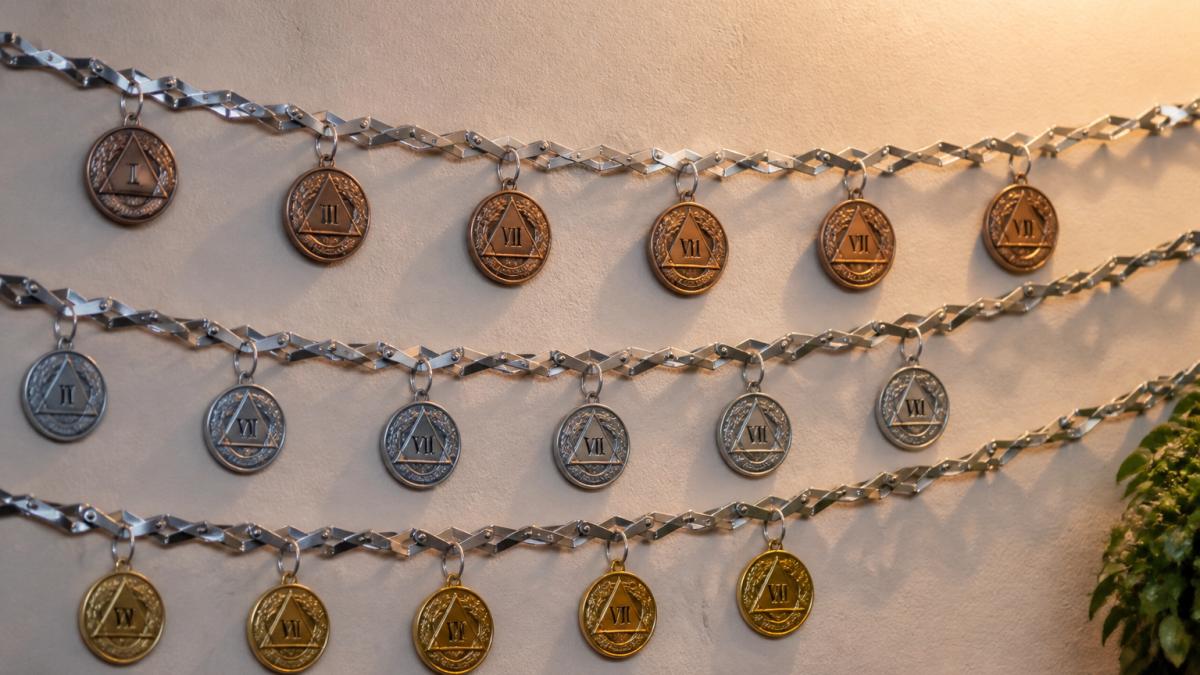
It grows with your journey: start with one link and one chip, then add a link at 30 days, 60 days, 90 days. The chain builds downward or horizontally, showing your entire recovery timeline at a glance.
Recovery Time Links offers individual links starting at $9.99 each, with volume discounts on multiples.

Setup is straightforward: each link has a magnet to hold your chip. Each link has a magnet to hold your chip. For larger chips, you'll need an extra magnet.
Best for: Anyone planning long-term recovery who wants a display that grows naturally with their milestones. Ideal if you have limited wall or shelf space but want maximum visibility.
Skip if: You prefer a completely static display or want all your chips visible simultaneously in a compact footprint.
2. Shelf Display with Individual Spacing
A shelf display gives chips breathing room: arrange each one individually across a shelf or bookcase, spaced out so each stands out visually.
It works in living rooms, bedrooms, or home offices with a shelf that gets regular attention.
You need a shelf deep enough to hold chips securely. A traditional bookshelf beats a floating shelf because the back edge stops chips sliding forward; small stands or chip holders keep each one upright.
This approach suits finite collections. Once the shelf fills up, you'll need a second shelf or a different method.
Best for: Early recovery (first 2-3 years) when you want each chip to feel significant and separate. Works well in visible family spaces where recovery is openly acknowledged.
Skip if: You have limited shelf space or plan to accumulate many more chips over decades of sobriety.
3. Wall-Mounted Timeline of Your Sobriety Journey
A wall-mounted timeline can present chips chronologically.
It requires more planning. Options include a narrow horizontal shelf, a frame with small hooks or magnets inside, or wire or string hanging chips at different heights.
Beyond aesthetics, the timeline shows progression: how much time has passed and what was happening between milestones, more meaningful than a random arrangement.
It suits programs marking specific milestones (30 days, 60 days, 90 days, 6 months, 1 year, then annual chips).
Best for: People who want their recovery milestone display to tell a story. Works well in personal spaces like a bedroom or home office where you'll spend time reflecting on the timeline.
Skip if: You prefer a simpler, less time-intensive display or don't have wall space available.
4. Desk or Nightstand Personal Reminder
Sometimes the most powerful recovery milestone display is the smallest: a single chip or a small cluster of recent chips on your desk or nightstand as a daily touchstone.
No formal system needed, a small stand, decorative box, or simple shelf works.
Best for: Anyone wanting a simple, low-commitment way to keep recovery visible. Works for all stages of sobriety, from 30 days to 30 years.
Skip if: You prefer to keep recovery private or don't have desk or bedside space.
5. Shadow Box or Glass Cabinet Display
A shadow box or glass cabinet creates a curated, museum-quality presentation, ideal for a smaller collection or a display that feels intentional and finished.
A shadow box is a shallow frame with a backing board: arrange chips inside with complementary spacing. Some add small plaques with dates or meaningful words; others keep it minimal.
A glass cabinet offers more space and three dimensions: chips on multiple shelves plus photos or mementos create a comprehensive visual story and a focal point you're proud to display.
Best for: People with a completed or near-completed chip collection who want a polished, finished display. Works well for milestone anniversaries or as a permanent home display.
Skip if: You're still early in recovery and expect to add many more chips. The fixed nature of a shadow box makes it less flexible than other options.
6. Portable Display for Meeting Rooms or Travel
Not everyone displays chips at home. Some want a portable recovery milestone display for meetings, retreats, or travel.
It might be a small case, compact organizer, or travel-friendly expandable chain.
Best for: People who travel, move frequently, or want to share their recovery milestone display with their recovery community. Works well for anyone who values portability.
Skip if: You prefer a permanent, stationary display in your home.
7. Private or Semi-Private Display Options
Recovery is personal, and not everyone wants chips on public display. A private or semi-private recovery milestone display keeps progress visible to you and those you choose, while maintaining privacy from casual visitors.
A private display might live in your bedroom, a closed-door home office, or a closet you open when you need the reminder. Semi-private means family see it but guests don't, a bedroom shelf or home office wall.
Recovery Time Link - Single - Sobriety Chip Display →
Recovery is yours; you don't owe anyone visibility into your sobriety journey. Open display and privacy are both valid. A recovery milestone display doesn't have to be public to be powerful.
Choose what works for your space. The difference is intentionality about who sees it.
Best for: Anyone who values privacy or whose living situation doesn't support open display. Works for all stages of recovery.
Skip if: You want your recovery to be visible to everyone in your home.
Sobriety Chip Display Ideas for Multiple Recovery Programs
If you've worked through multiple programs, you may have chips from different sources.
A recovery milestone display honoring multiple programs acknowledges a non-linear path: chips from different years, programs, and communities. That's real and honest.
The expandable chain lets you add links as you reach milestones.
With a shelf display or wall timeline, you can arrange chips by program, year, or chronology.
Your recovery milestone display can reflect your own journey.
Sobriety Medallion Display: Organizing by Year and Milestone
Some milestone displays include chips for 30 days, 60 days, 90 days, 6 months, 1 year, and later anniversaries.
You earn chips frequently in the first 18 months. The Zero-to-Whiner Kit is a display example for seven milestones from day one through 18 months; medallions are not included.
The catalog describes annual milestones as well as earlier milestones. With an expandable chain, you can add links as you reach milestones.
Some organize their sobriety medallion display by milestone type, all 90-day chips together, all one-year chips together, emphasizing the shared experience of those markers. Others organize chronologically, emphasizing time passed and the individual journey.
There's no right way. Your recovery milestone display should reflect how you think about recovery: emphasize the milestones that feel most significant, or use a chronological display to highlight showing up year after year.
Budget-Friendly and Space-Conscious Display Solutions
A recovery milestone display can be simple.
Rearranging an existing shelf is free; hanging chips on string or wire you already own costs almost nothing. The investment doesn't determine the meaning.
Recovery Time Links' individual links cost $9.99 each for quantities of 1-4, $8.99 each for 5-20, and $7.99 each for 21 or more; the discount applies automatically at checkout. The Zero-to-Whiner Kit is a display-only example priced at $69.93; medallions are not included. Individual links cost $7.99 each for quantities of 21 or more.
Space-conscious options include a narrow floating shelf or a small shadow box hung on a wall.
Limited budget or space can lead to creative displays using repurposed materials.
Privacy, Consent, and Displaying Your Recovery Story
Before setting up your recovery milestone display, consider who will see it and whether you're comfortable with that.
Living alone makes it straightforward. With roommates or family, a conversation may be worth having: some are proud to display recovery openly, others prefer privacy, and both deserve respect.
With children, you may choose to display your recovery milestone.
With guests, a semi-private display visible to family but not everyone entering your home maintains privacy while honoring recovery. Keeping chips in your bedroom or office rather than the living room is perfectly fine.
Consent matters in a shared recovery community: some display chips at meetings or retreats, others keep them private. Respect others' choices and expect the same for yours.
Your recovery milestone display is yours, reflecting your comfort level, values, and relationship with your recovery community. There's no obligation to display publicly and no shame in choosing privacy.
Choosing and Setting Up Your Recovery Milestone Display
Start with practical questions: How much space do you have? Visible to guests or private? How many chips do you have now, and how many do you expect to display?
Recovery Time Links' individual links let you start with one and add as you reach milestones.
To set up an expandable chain display:
- Choose the number of links you need
- Connect each link to the next
- Place each chip on its link (one magnet holds standard chips; larger chips need an extra magnet)
- Arrange the display where you'll see it regularly
For larger chips, you’ll need an 1x Extra Magnet for Larger Chips.

For a shelf display, you can space chips apart.
Choose a location where you'll see the display regularly, such as your bedroom or home office.
Your sobriety chips can mark milestones in your recovery. A recovery milestone display can keep those milestones visible. Whether a simple shelf, an expandable chain, or something more elaborate, you can choose a display that suits you.
National Institute on Drug Abuse resources on recovery support
SAMHSA's guide to peer recovery support
The American Addiction Centers' article on celebrating recovery milestones
| Display Type | Best For | Space Required | Cost Range | Expandability |
|---|---|---|---|---|
| Expandable Chain | Long-term recovery, growing collections | Minimal (vertical or horizontal) | $9.99-$79.99 | Unlimited |
| Shelf Display | Early recovery, limited chips | One shelf section | Free-$50 | Limited |
| Wall Timeline | Visual storytelling, narrative recovery | 2-4 feet of wall space | $20-$100 | Fixed |
| Shadow Box | Milestone celebrations, finished displays | 12-24 inches wall space | $40-$150 | Fixed |
| Desk/Nightstand | Daily reminders, portable | 4-6 inches | Free-$20 | 1-3 chips |
| Private Display | Privacy-focused, family-only visibility | Bedroom or office space | $10-$60 | Varies |
Frequently Asked Questions
How can I display sobriety chips at home if I don't have much wall space?
Recovery Time Links offers an expandable display system for sobriety chips. Consider your apartment's layout when choosing where to display your milestones.
Can I display chips from multiple recovery programs together?
The display system is modular and can grow as you reach milestones. The verified product information does not specify compatibility with chips from multiple programs.
Is it worth buying a sobriety medallion display if I'm only 6 months sober?
Recovery Time Links lets you start with one link and add links as you reach new milestones. Individual links cost $9.99 each for quantities of 1-4, $8.99 each for 5-20, and $7.99 each for 21 or more.
What should I do if I want to display my recovery milestone privately?
You can choose where to display your milestones based on your privacy preferences.
